Finding New Pathways
An action plan for criminal justice and mental health in Canada
In 2026, the Mental Health Commission of Canada released a national action plan for improving interactions between people experiencing mental health challenges and the criminal justice and forensic mental health systems. The action plan emphasizes the well-being of all individuals who interact with the criminal justice and forensic mental health systems, including justice-involved individuals, victims, and system workers.
Developed through a five-year process of collaboration, research and meaningful dialogues with individuals and organizations across the justice and forensic mental health sectors, the action plan is evidence-based, shaped by subject matter and lived expertise, and aligned with the needs of justice-involved individuals and justice system workers.
National Action Reference Guide
To help readers navigate the action plan and start thinking about how to implement its recommended actions, the Commission also released a companion reference guide.
What is the issue?
People living with mental health concerns and illnesses are overrepresented in the criminal justice system, with approximately 73% of men and 79% of women who are federally incarcerated in Canada meeting the criteria for one or more current mental disorders.
Lorem ipsum dolor sit amet, consectetur adipiscing elit. Ut elit tellus, luctus nec ullamcorper mattis, pulvinar dapibus leo.
- First Nations, Inuit, and Métis who represent 30% of the incarcerated population, despite representing about 4.9% of Canada’s population
- African, Caribbean, and Black communities who account for 9% of the total incarcerated population in federal corrections, despite representing about 4% of adults in Canada.
- People who work in the system also experience unique challenges that can have a significant impact on their psychological health and safety in the workplace. A 2019 report highlighted that public safety personnel, including correctional officers, dispatchers, and police officers, are almost 4.5 times more likely than the general population to experience symptoms of mental disorders.
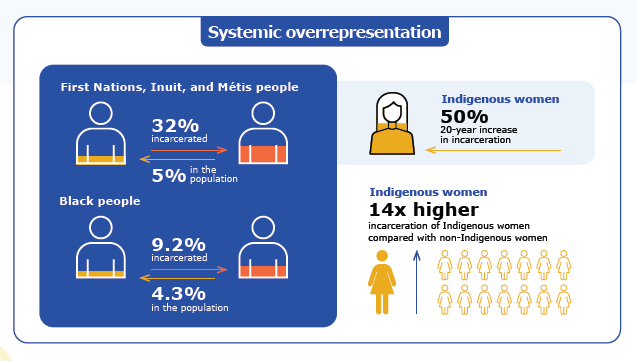
These statistics highlight that there is a lot of work to do to improve mental health outcomes for everyone involved in the justice system.
Testimonials
My hope is simple: this plan does not sit on a shelf. It must drive easurable action, strengthen reintegration, address mental health needs, and shift systems from punishment to dignity.
Mo Korchinski, BSW RSW
Why an action plan?
In response to the increasingly complex cross-jurisdictional Canadian landscape, the national action plan offers a practical roadmap for transformation that is evidence-based, shaped by lived experience and input from national subject matter experts, and aligned with the needs of justice-involved individuals and justice system workers.
The action plan is built on the foundational premise that the stigma and discrimination tied to mental illness, substance use, and criminal justice involvement needs to be addressed.
It also recognizes the critical importance of supporting the psychological health and safety of workers in the criminal justice and forensic mental health systems.
The action plan at a glance
The action plan has three strategic pillars
Care, not criminalization
All people in Canada should have access to health and mental health services and supports that help prevent their involvement with the criminal justice system. People living with mental illnesses should be diverted from the criminal justice system whenever and wherever possible.


Care during criminal justice involvement
People who do become involved with the criminal justice and forensic mental health systems should have access to high-quality, evidence-based care and supports (health, mental health, substance use, and social supports) where and when they need them. Services should be trauma informed and culturally safe. Where evidence-based care is not available, evidence-informed care should be prioritized.
Care after criminal justice involvement
People leaving the criminal justice and forensic mental health systems who still require treatment deserve continuity of care after their release, along with access to seamless, integrated mental health, substance use, and social services in the community
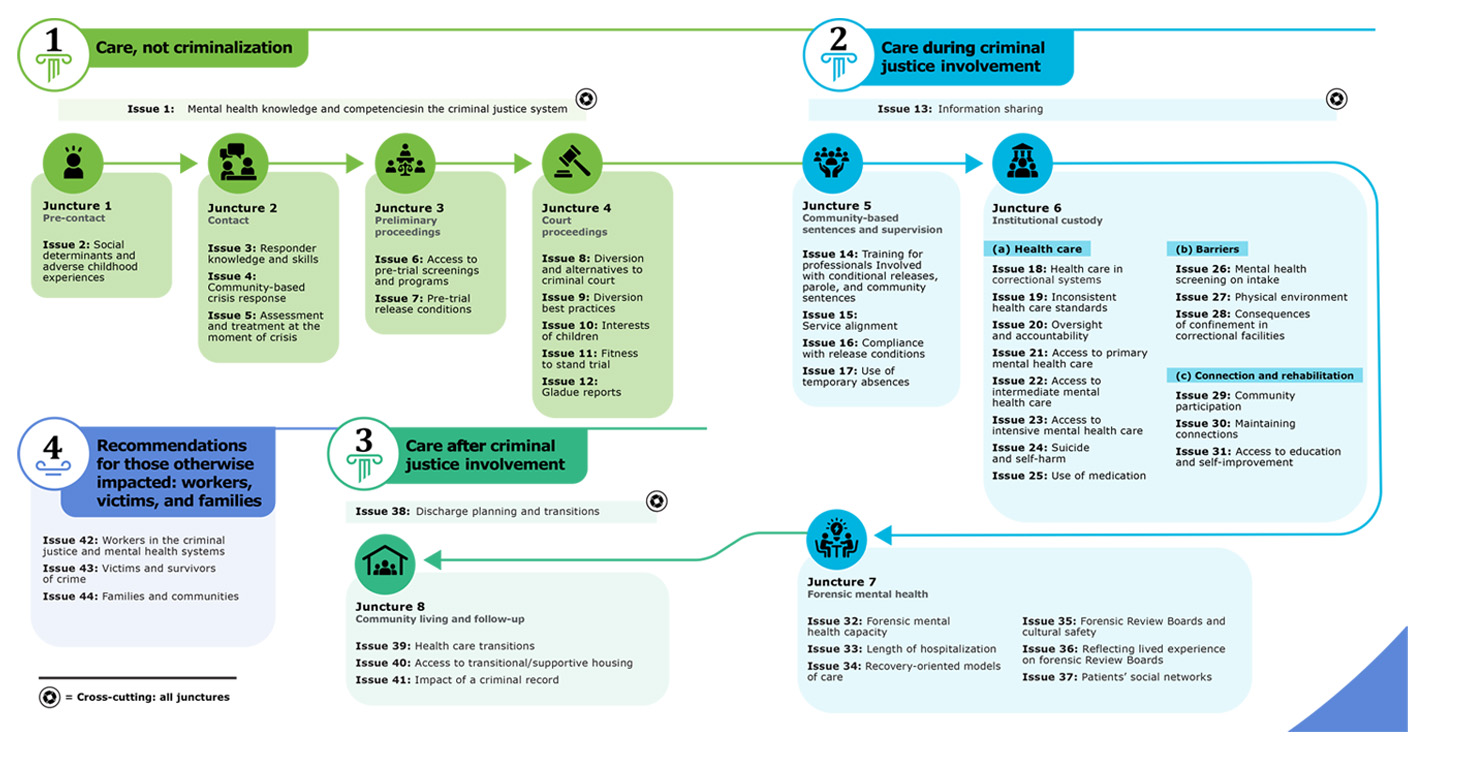
Each pillar is associated with a set of junctures — points of contact between people and the criminal justice or forensic mental health systems. Different issues arise at each of these junctures. The plan’s 68 recommended actions address those issues.
Beyond the junctures, part 4 outlines recommendations for people otherwise impacted by the justice system, namely workers in the criminal justice and forensic mental health systems, victims and survivors of crime, and families and communities.

Click here to review the Commission’s research and resources that laid the foundation for the action plan

Navigating the action plan: A Reference Guide
To support navigation of the action plan and to start thinking about how to implement its recommended actions, the Commission developed the companion Reference Guide.
The following diagram provides a high-level structural overview of the action plan, illustrating its components up to the issue level. For the associated recommended actions, please refer to the full action plan.
Navigating the action plan: A Reference Guide
To support navigation of the action plan and to start thinking about how to implement its recommended actions, the Commission developed the companion Reference Guide.
The following diagram provides a high-level structural overview of the action plan, illustrating its components up to the issue level. For the associated recommended actions, please refer to the full action plan.
Next Steps
Laying the foundation for the collective next steps required to achieve meaningful and sustainable transformation.
Meaningful and sustainable transformation is within reach for Canada.
While these transformative changes cannot be implemented by one group alone or overnight, it is imperative that action is taken today.
This action plan is a starting point that can be adapted to local contexts to share data, recommendations and examples of real-life practices. It centralizes information that can be applied in a decentralized system.

Connect with us
Putting the recommended actions into action will be a years-long, collective process requiring effort from governments at all levels, correctional authorities, forensic mental health providers, criminal justice professionals, community organizations, and many others.
For its part, the Mental Health Commission of Canda continues to explore opportunities and partnerships to strengthen collaboration and drive collective momentum for implementation.
Tell us how you are actioning, adapting and/or applying the recommendations from Finding New Pathways: An action plan for criminal justice and mental health in Canada. Together, we can identify, spread and scale meaningful and sustainable transformation.