
Christine Hooper
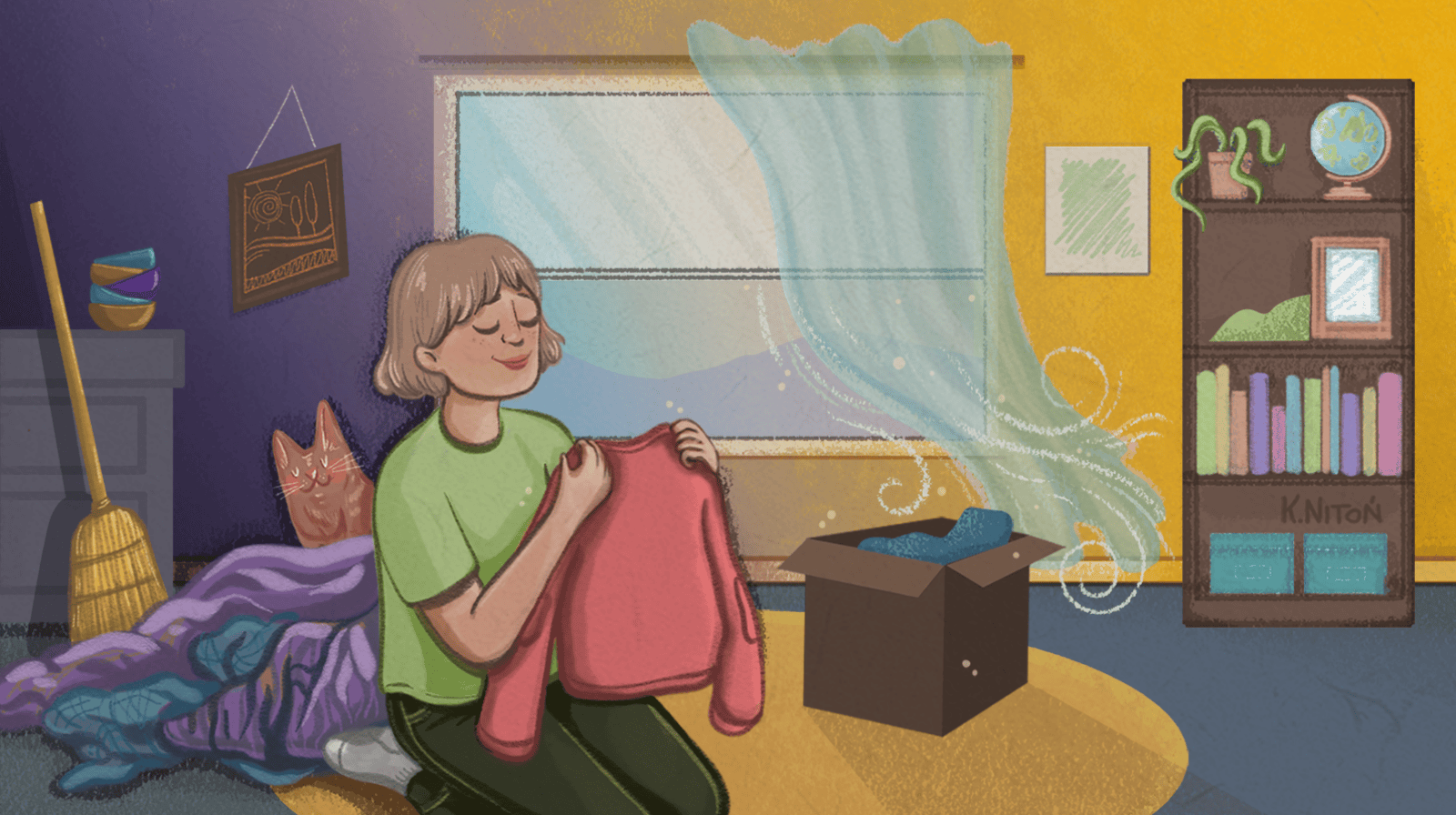
Since she lives in a modest one-bedroom, Hooper was surprised to discover how much had accumulated over the years. But, after months of going through all her stuff, she slowly transformed a crowded bachelorette pad into a lean apartment equipped only with things she needed or truly loved.
The experience also made her realize how good “spring cleaning” projects made her feel. She even started volunteering to help friends transform their spaces, which she said felt like a “creative act.”
Could your dust-buster double as a stress buster?
Hooper’s sense that cleaning can help you cope with difficult situations is starting to get a little scientific backing, despite the fact that very little research on any possible connection had been conducted until 2023, when “Actual Cleaning and Simulated Cleaning Attenuate Psychological and Physiological Effects of Stressful Events” hit the stands.
An international team that included researchers from the University of Toronto found an association between the physical act of cleaning and the lessening of “residual anxiety” from a “stress-inducing physical scene.” Cleaning helped boost “adaptive cardiovascular reactivity,” a physiological reaction that can make it easier to cope with stress.
That may have been the first physiological evidence, but anecdotally, many humans had already observed this. For musician and writer Blair Frodelius, the therapeutic qualities of cleaning have been clear for a while. “I feel less pressure, less anxiety, and less stress in my life,” he says. “I guess the best word to describe it would be ‘unburdened.’”
Which may be why many, if not most, cultures and religions have rituals that involve sweeping out the bad energy to make room for good vibes, be it Lunar New Year or Guatemala’s La Quema Del Diablo, which involves giving the house a deep clean, then burning the devil in effigy.
“There are a lot of cultural components and cultural messaging that have to do with cleaning,” says Dr. Natasha Williams, a registered psychologist. “I was born and raised here in Canada, but my family is from the Caribbean, where cleanliness is often talked about as next to godliness, you know?”

Dr. Natasha Williams
Growing up, Williams recalls the whole family pitching in to scrub the washboards and fold the laundry so that everything was spotless on Sunday — and ready for the start of the new week. The value of that experience has stayed with her, to the point that her dynamic practice in Toronto melds advice on mental health and empowerment with ways to declutter all the spaces — physical, mental, and even digital.
“The thing is that mental health is whole health,” Williams adds. “So that includes physical health, our social environment, and our physical environment. If your environment is cluttered, that is going to impact the way that you cope on a day-to-day basis.”
Less is more for many, but not for everyone
Williams stresses that cleaning is a highly individual issue. Some find comfort in a cozy room full of memorabilia and stacks of books; others prefer a sparse space.
Clare Kumar, whose Happy Space Podcast is all about neuro-inclusion and design, says the gap between minimalists and maximalists goes beyond personal taste and decorating trends.

Clare Kumar – Photo: Dan Coutts
“Some people can become overwhelmed by too much visual stimulation,” explains Kumar, who also used to be a professional organizer. “I think a strategic restoring of order in a space can sometimes be a nervous system regulation. I call it a ‘moment of exhale’ because I find it starts to calm us down.”
Hunting for treasure without ever leaving home
Still, even people who are highly motivated to dial down a room’s sensory overload might struggle to let go of certain things.
“I tell people to look for treasures, so I try to reframe it in a really positive way rather than devaluing things by calling it ‘clutter,’” says Kumar. “Identify the things you really know you want to have in that space, then infuse them with joy and celebration rather than guilt.”
Wendy Stone, founder of Halifax’s Lighten Up Organizing, a trauma-informed service, agrees that using positive, judgment-free language is especially important when “stuff” is part of a coping mechanism.
Wendy Stone
“If you have somebody with severe trauma issues around their things, you can’t call it junk or garbage or just start by asking if they really need it,” says Stone, who has transformed countless homes into well-organized spaces since she founded her business in 2018. “You need to ask why they’ve kept it and then talk about it before you can ask whether they need it.”
Stone remarks that it’s a slow process. And it should be. She recommends not planning to do a whole house or apartment on a single weekend. “It’s all about keeping the focus in a very small space,” she says.
“But it’s so important to try to work on making your home a place you feel good about and feel safe in,” Stone continues. “Because, really, I think our spirit is attached to our space.”
Practical tips from our panel of neatniks:
- An orderly and clean house is great, but don’t strive for perfection. “Because we’re human beings and human beings are not perfect, there’s no such thing,” says Dr. Natasha Williams. “Perfection is a myth.”
- “Start small,” Blair Frodelius advises. “Five minutes a day equals two and a half hours per month. So, if you can do 10-20 minutes a day, wow!” If you need a prompt, he notes there are apps that remind you to do all sorts of tasks — from the kind that only come up a few times a year to regular daily or weekly chores.
- Wendy Stone advises: If you’re sorting stuff in the bathroom and you find a hammer, don’t immediately take it to the tool room. Instead, sort in place and make piles. “We’re not going to move around the house,” she says, “When we’re done, the stuff that goes to the kitchen or the living room goes all at once. That saves your energy and you’re more likely to finish the task at hand.”
- Christine Hooper recalls that she ran across a stack of love letters from her first boyfriend during the big dig of her apartment. “I read every single letter. Then I chose my favourite and got rid of the rest,” she says. “Sometimes people keep multiple things that remind them of a person or time in their life. You often only need one.”
- Getting rid of things can feel wasteful and few of us want to feel like we’re contributing to a landfill. Clare Kumar counsels people to look to local charities that need donations for gently used items so they get a second life. “I’ve always wanted to make a TV show that takes unwanted items and follows them to homes where they become treasures.”
Cleaning rituals around the world
In parts of the Middle East, Central Asia and the Balkans, humans have been celebrating Nowruz, a spring equinox celebration, for over 3,000 years. There are many components to the festival but one important one is “shaking the dust” — cleaning house before the equinox.
Better known as Swedish death cleaning, Döstädning isn’t an annual ritual but instead a philosophy that espouses simplicity and minimalism at any age. The name may sound morbid but, in the end, keeping things clean is about caring for loved ones by making sure they aren’t, one day, burdened with a house crammed with possessions. And helping family and friends is good for us, too.
Most of us know all about ridding ourselves of items that fail to “spark joy,” thanks to Marie Kondo’s books and TV shows. Fewer people know that Kondo took inspiration for her work from Ôsôji, a traditional Japanese cleaning exercise designed to let go of regret to make room for all the good fortune and energy coming in the New Year.
