
Share This Catalyst


Firefighter Steve Jones on the merits of The Working Mind First Responders course
When firefighter Steve Jones first completed his course to become a trainer for The Working Mind First Responders (TWMFR), he was encouraged to share some of what he’d learned with his crew.
“What I thought would be a 15-minute conversation turned into three hours,” said Jones, an acting platoon chief with the Burlington Fire Department. “Guys opened up about serious mental health problems in their families and in themselves, things that I had no idea were going on. That was the moment it hit me — we all know someone who’s struggling.”
TWMFR, which has recently been updated and adapted to a virtual format (until in-person learning can safely return), is designed to build awareness, reduce stigma, strengthen resilience, and encourage mental health conversations among first responders.
Participants are introduced to tools like the colour-coded mental health continuum to increase self-awareness, as well as to coping strategies and resources to better support themselves and each other.
Jones notes that while the material is deceptively simple, its impact extends far beyond the classroom. “Trajectory is one of the most important concepts. One short conversation about mental health, or the moment of courage it takes to say “I need help,” can alter someone’s trajectory forever. That’s what makes this course so powerful.”
A series of double standards
Part of that trajectory shift comes from the course’s emphasis on reducing stigma, which as Jones points out, often manifests as double standards around mental illness.
“When someone returns to work after a back injury, we don’t question whether it’s going to hold up on the job. We trust the process to clear them for duty and move on. But when someone returns after a psychological injury, that implicit trust isn’t there.”
Even more pervasive, he says, is the self-stigma that often comes from admitting one’s own struggles or having sought support — a point he tries to emphasize as a facilitator.
“I’ll ask my group to raise their hands if they think their crew would come to them if they needed to talk, and most hands go up. Then I turn the table, and ask if anyone would reach out to a teammate to share their own challenges, and the response is much different. First responders want to help people, but asking for help is a whole different beast.”

Steve Jones
Saving lives begins at the station
Recognizing stigma as a barrier to support his own department is partly what led Jones to become a trainer for TWMFR. Since then, the course has been rolled out across Burlington Fire, leading to a palpable culture shift (and an increase in employee and family assistance program use) that has resulted in other departments reaching out for guidance.
While Jones’s enthusiasm for TWMFR is largely driven by the positive impact it’s had in his own department, it’s the transformation he sees in his participants that continues to feed his passion. “There’s nothing more rewarding than having someone come up to me at the end who says, ‘I really needed this,’ he explained.
“I truly believe I’ve saved more lives in my five years as a trainer for TWMFR than in my 20 years as a firefighter.”
That sentiment was echoed early on in Burlington Fire’s rollout of the course by a surprise guest speaker — a retired fire captain who had asked to speak to the group at the beginning of a session.
“He reminded us that, as firefighters, we invest hours into training that will keep us safe in the field. There are drills for all types of situations so that when the floor gives out beneath you, all you have to do is call ‘mayday’ and you’ll be rescued. . . . But when you’re struggling with a mental health problem, and it feels like the floor is giving out, there is no ‘mayday.’ By training to protect our mental health, we’re training to save lives.”
As Jones recalls, the message struck a chord with everyone in the room. The retired captain was not only a well-respected mentor, he was someone who had seen the consequences of neglecting mental illness across his career, including losing a teammate to suicide.
“After that day, he came back and spoke to every training group before the start of the course. No matter how many times I heard it, his words hit home and my trajectory shifted a little bit more.”
To learn more about the benefits of TWMFR Virtual for your organization, contact solutions@openingminds.org
Share This Catalyst
An impossible juggling act
Because the effects of the pandemic are not felt equally, the Mental Health Commission of Canada (MHCC) is turning its attention to populations that are disproportionately affected — including women.
“Women make up the majority of our organization,” said Karla Thorpe, the MHCC’s vice-president of Public Affairs and Organizational Performance. “Every day over the last year, we’ve been hearing from female staff in particular about having to juggle an impossible number of tasks, and we need to recognize that these realities have mental health ramifications.”
Thorpe herself is all-too-familiar with the mental toll arising from the COVID era’s push and pull.
“Personally, this past year was among the most challenging I’ve weathered. I had to move my elderly parents into a care home at the height of the pandemic. With long days of Zoom meetings, followed by caregiving visits in full PPE, there were times when normalcy felt so far out of reach,” she recalled. “Yet, I recognize my own good fortune. The challenge for those who have had to take longer-term leaves or don’t have the luxury of paid time off is even more complex. This is especially true for people without the resources to seek the support they need.”
A disproportionate toll
Women are no stranger to the role of primary caregivers, which is why up to one-third of working mothers have considered quitting their jobs since the onset of COVID. And the weight of leaving the workforce can be a heavy burden.
That’s why the MHCC created a mini-guide specifically designed to support the mental wellness of women who have been sidelined from the workforce, whether by pandemic business closures, caregiving, or other responsibilities.
Liz Horvath, manager of the MHCC’s Workplace Mental Health team, was game to support this resource from the word go. “I’ve walked a mile in those shoes,” she said, referring to a dark time when she was waitressing to support her child as a single mother. “I was studying, working, parenting, and all the time made to feel that my contributions weren’t valued, weren’t worthy. I was considered “just” — as in just a waitress. I was on a treadmill that was grinding me down.
But when I left that work in search of some greater meaning, I was faced with significant barriers despite the valuable knowledge and skills I had gained as a single mother, a waitress, and a student,” she explained. “The constant struggle wore down my resilience and left me in a state of crushing depression, at a time when stigma was very high and access to support services was really limited.”
Recalibrating for mental wellness Yet there are ways, Horvath acknowledged, to walk a path of unemployment without losing confidence and connection. Equally, there are ways to create some space for self-care, even when the scales are tipped heavily toward workaday realities.
“Staying connected sounds trite, but it’s so important,” she said. “Whatever your area of work, from front-line service to the corner office, there are online groups or forums, volunteer opportunities, career counselling, and online aptitude tests. Embracing these types of connections, when I could, was very helpful.”
Thorpe concurred, adding that, “for women, confidence can be a stumbling block, especially during times of unemployment. That’s one reason we designed this resource to help women reframe their thinking. A gap in a CV is an opportunity to demonstrate experience that was gained outside the workplace. A set of skills we’ve learned in one area can be applied to another — because it’s our capacity to learn and grow that’s important.”
The mini-guide is an easy-to-use reference guide, with practical tips and resources on everything from mental health supports to financial literacy.
“In the winter, the MHCC had created a tip sheet to help employers support and welcome women returning to work after an absence,” said Horvath. “But we realized there was still an important gap to fill. What about the wellness of women during that time away? How can we make sure they feel supported?”
Supporting each other
For Thorpe, being a woman in a leadership position comes with an added responsibility. “As a female leader, I want to help break down the systemic barriers women continue to face in the workplace. Too often women take themselves out of the running for a job without even applying. Or we don’t ask for mentorship or we fail to negotiate a raise. As leaders, male and female, some of the onus for changing our systems, processes, and cultures at work to accommodate the realities of women’s lives — so we get the best possible talent — is on us.”
Horvath agrees, and is hopeful that resources like the new mini-guide will help women see their futures in a brighter light. “Taking an absence from the workforce comes with all kinds of challenges, but it also brings fresh opportunities. With the right support, the ending of one chapter can lead to a better one. I know it did for me.”
Share This Catalyst
MHCC welcomes new president and CEO Michel Rodrigue

Michel Rodrigue
Change is never easy, conceded Louise Bradley, C.M., outgoing president and CEO of the Mental Health Commission of Canada (MHCC).
“But that doesn’t mean it isn’t necessary,” she said from her home office in Newfoundland, where she’s been working throughout the pandemic.
“I spent a lot of time reflecting as I went on early morning hikes. Moving on from the MHCC wasn’t a decision that was taken lightly . . . but once it was made, it did feel like a weight had lifted.”
Bradley has been championing the advancement of mental health for her entire career, beginning with her earliest days as a nurse on a psychiatric unit. “People expressed sympathy, implying that I wasn’t up to snuff for a real nursing job,” she said, laughing. “I can see the humour in it now, but at the time it was cutting.”
For over a decade, Bradley has brought her expertise on direct health care provision and administration to the MHCC leadership table, and that effort has borne fruit.
“I look at where we are today, and my heart really does swell with pride at our collective achievements. Truth be told, that’s when I knew it was time to step aside. I never wanted to leave a job undone, and with a new strategic plan in hand, deeply committed leaders and staff, and exemplary partnerships, it’s time to pass the baton to someone who is ready to tackle the next ten years.”
Passing the baton
MHCC board chair Chuck Bruce conceded that Bradley’s decision took him by surprise . . . at first. “But then I reflected on what it means to be a CEO for a full decade. And Louise went above and beyond running the place. She took it upon herself to speak to countless audiences in Canada, and around the world, to change minds, to open hearts, to open doors. And that level of commitment is what you see reflected in the strategic plan the board envisioned.”
It is appropriate, then, that the architect of the new plan — Answering the Call — would be the person stepping into the role of president and CEO on March 24. As vice-president of Public Affairs and Organizational Performance, Michel Rodrigue has been walking in lockstep with Bradley for the last five years. In that time, he has helped to create a culture of forward-thinking innovation that has led to key breakthroughs like championing the Stepped Care 2.0 e-mental health initiative and knitting together communities in the name of suicide prevention with the national Roots of Hope program.
An eye to the future
“When we were building this new plan, I didn’t know how the future would unfold, but I did know that the board had a bold, ambitious vision that built on the foundational pillars Louise embedded in our organizational culture,” said Rodrigue. “And now, as we embark on the next decade, we can take the knowledge we gain, year over year, and compound our progress.”
Rodrigue, a CPA by trade, with wide-ranging executive leadership experience, believes his greatest asset is curiosity. “I am someone who loves learning, loves challenging myself, and loves being challenged. I went back to school later in life to complete an executive MBA and become a chartered professional accountant, and I found that experience energizing. Too often we become entrenched in our identities, but I think we have to constantly revise our thinking.”
In good hands
Bradley believes Rodrigue’s open-mindedness will serve him well. “The mental health landscape is constantly changing. Best practices are always emerging. You can’t afford to be static in your thinking, and Michel is someone who is willing to listen to the experts and is unafraid to change course.”
Bruce agrees. “We had an exemplary list of candidates, as you might expect for an organization as well respected as the MHCC. But Michel rose to the occasion time and again in the process. He not only understands the organizational culture and helped set us on a course for the next decade, he also has the kind of questioning mind-set that goes hand-in-glove with quiet confidence. You cannot run this organization without a willingness to bring a learner’s mind to work every day.”
As the MHCC begins a new work plan with a new president and CEO at the helm, Bradley for her part, has one last question.
“I wonder what great things the organization will do next?”
Share This Catalyst

Stephanie Knaak
In conversation with structural stigma researcher Dr. Stephanie Knaak
Stephanie Knaak has been studying structural stigma for the better part of a decade. She’s an expert in the foundational policies, laws, and practices in our health-care system that put people who live with mental illness at a disadvantage.
“But that doesn’t mean I have all the answers,” said Knaak from her home office in Golden, B.C., where she’s been working since the onset of the pandemic. “Sometimes I get overwhelmed. It’s a beast of a challenge to tackle because some people can’t see structural stigma, and others are suffocating under its weight. It all depends on where you’re sitting.”
When asked how something so invisible to some and dead obvious to others can be addressed, she paused. “In health-care settings, if you aren’t measuring it, it just doesn’t matter. We’ve got to show providers and administrators the true cost of these blind spots by giving them tools that can bring them to light. Then, we’ve got to use the evidence of those gaps to make a case to close them.”
New frontiers
Knaak and her colleagues at the Mental Health Commission of Canada (MHCC) are charting new territory. For example, they are mapping out the topography that people living with mental illness must face when seeking basic physical health care.
“A person’s mental health may have nothing to do with the reason for their visit, but it becomes a huge barrier to getting timely and proper diagnosis and treatment — because physical complaints are often dismissed or seen only through the lens of their mental health diagnosis. The system doesn’t have the right checks and balances to make sure these kinds of blind spots get caught,” she explained. “This is the equivalent of a mountain, and we’ve got to identify it on a map so we can point to it and say, ‘How are we going to scale this?’”
Unlike the early explorers who were blind to their own limitations, Knaak approaches this new body of research with the humility born of experience.
“We’re finding out new things every day. This area of study is massive. It’s almost intimidating to put a stake in the ground, because its constantly shifting beneath you. But someone has to be first. Someone has to say, “OK, we have to get better because people are bearing the consequences of system inertia. We’ve got to get the wheels in motion. Even if we have to backtrack and start again, we’ve got to get moving.”
If you build it . . . they will come (around)
Knaak believes that by forcing policy change in health-care settings a different attitude will follow. “Take handwashing, for example. Because it has standards for when, where, and how to do it, hospitals measure it so they don’t fall outside the protocols. If we want things to change for people living with mental illness, we need to write protocols that explicitly name and address the behaviours that are manifested by structural stigma.”
“In a way, it’s easier to change the mind of one individual,” said Knaak, who has worked to develop many of the MHCC’s Opening Minds anti-stigma training programs. “But what excites me is the ripple effect when you’re doing work to change the entire culture of care. It has the capacity to improve the experience of every person who walks through the door.”
Putting a stake in the ground
Up next for Knaak and the structural stigma team is creating the tools to help organizations plot a course toward improved care. This could include structural stigma report cards, client satisfaction surveys, and other measurement tools.
“It’s all in the service of identifying the barriers and pitfalls that can create such dispiriting and damaging experiences for people when they are vulnerable and at their place of greatest need,” said Knaak. “Essentially, we’re asking people who are working hard within a flawed system to unlearn what they’ve been conditioned to believe and to be open to doing things differently — not only as professionals, but as people.”
Knaak is referring to the way stigma is so imprinted on the DNA of organizations — as well as our own. “It’s like stigma at the cellular level, literally. It’s thrumming below the surface all the time, and it can erupt at any moment with disastrous results.”
When the professional becomes personal
Knaak is familiar with what that looks like. She has watched a loved one try to get help from a system that is not designed to effectively address the needs of a person living with mental illness.
“It’s ironic that my work came home to roost. All the things I was documenting as a researcher were laid bare. I had data points and key informant interviews and hundred-page reports. They all said the system was broken. But when you experience it up close, how it sometimes impedes the healing process more than it helps it along. . . . For me, this work has now become more personal, and more imperative, than ever before.”
When asked what success looks like, Knaak’s answer is surprisingly simple. “I often hear my family members who’ve experienced cancer laud the system for the timely, effective, compassionate care they received. All I want is the same thing when someone experiences mental illness.”
“Surely,” she said, “that’s not too much to ask?”
This is the third in a three-part series on structural stigma. Previously we talked to a care provider and a service user.
Share This Catalyst
MHCC launches virtual course — delivered by first responders, for first responders
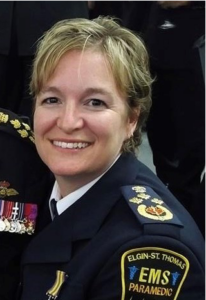
Pauline Meunier
For Pauline Meunier, a paramedic of 26 years, it took a trip to the allergist to give her anxiety a name.
“What I thought were allergic reactions turned out to be panic attacks,” she said. “Before I was asked about anxiety, it never occurred to me that my mental health could be the problem.”
That difficulty in recognizing one’s own mental injury or illness, she explained, is common among first responders, as is the undertone of stigma or self-stigma that may prevent someone from seeking help.
Now, as a training and delivery specialist with the Mental Health Commission of Canada’s (MHCC’s) Working Mind team, and a facilitator for the new The Working Mind – First Responders (TWMFR) Virtual course, Meunier is helping to break the cycle.
“First responders know that taking care of their physical health is critical to performing at their best,” she said. “Through this training, we want them to understand that caring for their mental health is equally important.”
The freshly revamped course is now being delivered virtually (until it becomes safe again to do so in person). Using an evidence-based approach, it gives first responders the knowledge they need to self-assess and also to talk about mental health — including strategies to help them cope with challenges and resources to seek out when they need support. To maximize the material’s resonance, its scenarios and terminology are tailored to each relevant group (e.g., paramedics, firefighters, police), and the course’s facilitators all come from first responder backgrounds.
A mental health pulse check
For those who work in the helping professions, especially in the extreme situations faced by first responders, it can be easier to recognize distress in someone else than in oneself. But the course’s mental health continuum model offers a way to help them do so. It matches a range of thoughts, attitudes, and behaviours to a colour-coded mental health spectrum: green (healthy), yellow (reacting), orange (injured), and red (ill).
For Meunier, that continuum — in the form of a wallet card — led to her own personal breakthrough.
“While attending a presentation, I was staring at the miniature mental health continuum on my table when it struck me — I was deep into the orange and I needed help,” she said. “As paramedics, we aren’t good at putting ourselves first. But as I learned first-hand, the continuum can be an effective tool for all first responders to check in with themselves and recognize when they need extra support.”
Leveraging language
One new component in the updated course is an emphasis on language. Based in part on the MHCC’s Language Matters guide, participants learn the value of using person-first language (where appropriate) as a powerful way to reduce stigma around mental illness and substance use.
Based on research showing that labels like “crazy” or “addict” can perpetuate stigma and discourage help seeking, participants are encouraged to use language that paints a more accurate picture by putting the human first and the condition second; for example, “this person is living with a mental illness or an addiction.”
“In the field, it’s easy to rely on labels as a sort of shorthand for easier communication,” Meunier explained. “But if we make an effort to use respectful language, we can help overcome stigma rather than contribute to it.”
The way forward
While there is still a long way to go in reducing stigma and establishing parity between mental and physical health among first responders, Meunier is hopeful for the future.
“If there’s one group who cares about excelling at their jobs, it’s first responders,” she said, adding that with the help of courses like TWMFR Virtual, the idea that mental wellness is part of that success is gaining traction.
“The most rewarding thing about facilitating these courses is receiving messages from participants who say things like, “it all makes sense now” or “this explains so much.” Those moments of realization can be life changing — I know it was for me.”
To learn more about the benefits of TWMFR Virtual for your organization, contact solutions@openingminds.org
Share This Catalyst
Share This Catalyst
Share This Catalyst
Share This Catalyst
Ambitious 10-year strategic plan aims at transformational change in Canada’s mental health landscape
 For Chuck Bruce, board chair of the Mental Health Commission of Canada (MHCC), the need to invest in mental health isn’t a question — it’s an imperative.
“I’ve worked with tangible investments my whole career,” said Bruce from his home office in Newfoundland and Labrador, where he runs the province’s largest public sector pension fund. “I typically see a return in terms of dollars and cents — but you can’t put a price on mental wellness.”
That’s why Bruce, together with the MHCC’s board of directors, set out to draft a blueprint that could help renovate a mental health system with dangerous gaps and cracks still running through its foundation.
Building on past successes
“Answering the Call isn’t prescriptive,” he said, referring to the MHCC’s freshly released 10-year strategic plan. “It’s a bold, ambitious vision to uplift the voices of lived experience, enhance co-operation across our many partnerships, and dig into those areas that have been overlooked far too long. We cannot afford to stall the progress on mental health promotion, mental illness prevention, and supports and treatments just as we are hitting our stride as an organization.”
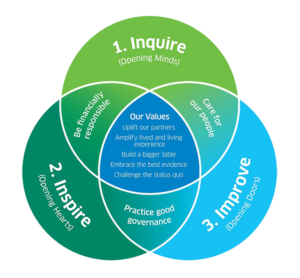
The new plan is supported by three pillars: Inquire, Inspire, and Improve. For Bruce, “they are the lifeblood of what we do at the MHCC: We open minds by seeking out the best research and disseminating it. We open hearts by combating stigma in all its forms — including structural barriers (that are as invisible as they are dangerous). And we open doors with improved access to services through cutting edge demonstration projects.”
The right frame for growth
“As a board, our job isn’t to tell the experts who make up the MHCC’s leadership and staff how to go about creating this change. For the same reason, I wouldn’t tell a builder where I wanted load-bearing walls or how to engineer my bathroom. Instead, I might say, I want an open concept home with lots of light.”
In the new plan, the MHCC’s board has left plenty of room for the creativity, responsiveness, and entrepreneurship that have been a hallmark of the organization’s first decade.
“When I first became acquainted with the MHCC, on their workplace advisory committee, my knowledge of the organization’s footprint was reasonably narrow,” said Bruce. “Many years later, I’ve come to realize that, while we’re a relatively small group, we’re spotting and plugging holes at every turn. From community-based suicide prevention to creating mentally healthier university and college campuses or delivering resiliency and anti-stigma training, we make use of every last funding dime to create the kind of society that reflects our shared ideals — recovery chief among them.”
The road ahead
When asked what success might look like for the 10-year plan, Bruce paused. “I don’t want to predict where this plan will lead us because I believe in the power of compound knowledge.”
The idea is built on the investment principle that dollars increase over time through the strength of compound growth. “It’s the most powerful tool we have to create wealth,” he said. “And reinvesting in the knowledge we gain is the most powerful means to create transformational change.”
For Bruce, that change is within our grasp — and always has been.
“When my mother was diagnosed with breast cancer 25 years ago, my father didn’t want it discussed. It was family business, and it was private. Period.”
On reflection, Bruce suspects that shame played a role in his father’s perception of breast cancer. “And he wasn’t alone in that. But over the years, we’ve seen the Run for the Cure gain momentum and grow, we’ve seen the CN Tower light up pink, we’ve seen speciality appliances and lipsticks with a portion of proceeds going to breast cancer research. And the implicit message in all of this is that there is no shame. I’d say it has worked for many health issues, but we aren’t there yet when it comes to mental illness.”
Measuring progress
If the MHCC’s strategic plan is successful, Bruce said, there will be similar markers along the way.
“We’ve got to celebrate the victories. The e-mental health interventions that hurdle geographic barriers. The standards that are changing how we study and work. The Mental Health First Aid program that’s trained more than 500,000 people in Canada (and counting). Each of these is narrowing a gap or filling a crack. Building a solid foundation.”
And until that work is done, Bruce is convinced that by reinvesting our knowledge to open minds, hearts, and doors, there will be a marked net profit.
“I’m a numbers guy, after all,” he conceded. “We’ll be measuring our returns and reporting on progress to our key investors — and that’s every single person living in this country. Because mental health . . . matters to all of us.”
