
Are You There Judy? It’s Me … Midlife Margaret
Subscribe to Catalyst
Subscribe to get our magazine delivered right to your inbox
Related Articles
Related Articles
Are You There God? It’s Me, Margaret was our tender, funny guide through the mortifying terrain of adolescence.
At midlife? We’re on our own.
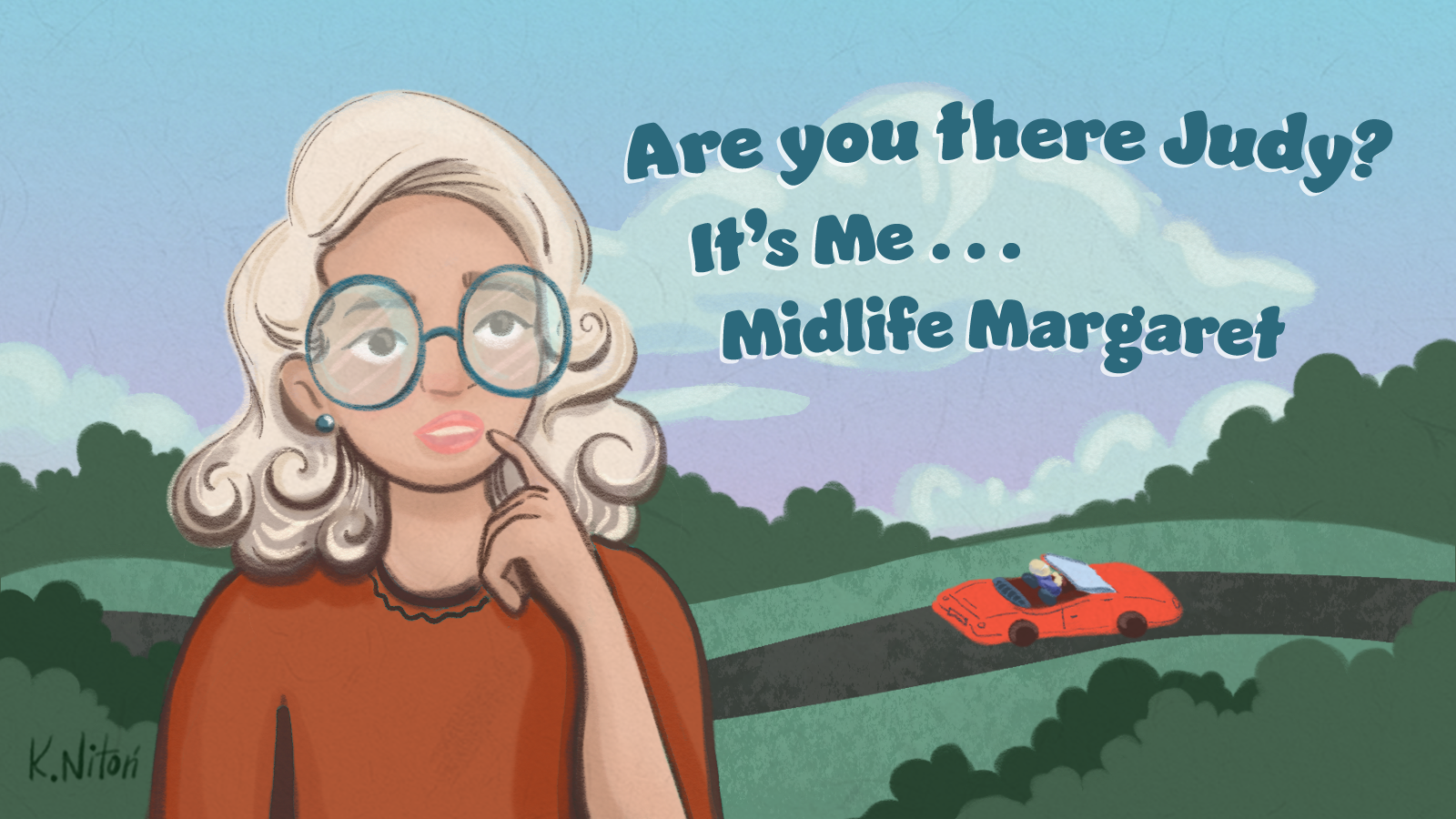
From American Beauty to Mad Men, the male midlife crisis is a cultural obsession — complete with sports cars, affairs, and existential breakdowns.
Take my dad. In his early 60s, he bought a black Mustang GT convertible, beautiful but impractical, a coupe with negligible legroom. We still had a family dog, and my parents regularly made long drives. My mother recalls a juddering so relentless that every few kilometres she double-checked her fillings hadn’t fallen out.
While he conformed to the trope of the male midlife crisis, the reality is a little starker.
Midlife can be a period of reflection, a grab bag of unmet goals and shifting roles. My dad had recently retired, but his job had been central to his identity. His kids were grown. He began offering (not so helpful) observations on my mother’s vacuuming. In retrospect, the car was a stand-in for feelings of grief and loss he couldn’t articulate.
Given that men have been conditioned to externalize distress — acting out in anger, masking depression through workaholism — it makes sense that someone identifying as male might address midlife malaise with a big-ticket item.
A fast car equals a new lease on life. Problem (not quite) solved.
Are you a woman over 45? Pass me the eraser
It’s trickier to find evidence of the female equivalent.
As Ada Calhoun writes in her seminal book, Why We Can’t Sleep: Women’s New Midlife Crisis,
From the outside, no one may notice anything amiss. Women might drain a bottle of wine while watching TV alone, use CBD edibles to decompress, or cry every afternoon in the pick-up lane at school. Or, in the middle of the night, they might lie awake, eyes fixed on the ceiling. There has yet to be a blockbuster movie centred on a woman staring out her car’s windshield and sighing.
Society has a terrible habit of literally erasing women of a certain age from public discourse.
Here I’m thinking about Lisa LaFlamme, the estimable CTV anchorwoman who embraced natural silver locks during the pandemic and disappeared from screens shortly thereafter.
In the United States, a lawsuit against the media company Meredith Corporation highlighted the age disparity between men and women on TV news. Writes Calhoun, “In five years the company removed seven female anchors with an average age of 46.8 and replaced them with younger women, whose average age was 38.1 … male anchors remain a decade older, on average, than their female co-anchors.”
Cause and effect? You decide.
On top of this, as women, we’ve been socialized to internalize our feelings.
You come to this place, midlife. You don’t know how you got here, but suddenly you’re staring fifty in the face. When you turn and look back down the years you glimpse the ghosts of other lives you might have led. All your houses are haunted by the person you might have been.
-Hilary Mantel, Giving up the Ghost
So, if we don’t see ourselves, or our crises, play out publicly, it can lead us to believe we don’t need or deserve psychological help.
“A middle-aged woman’s midlife crisis poses a dramaturgical problem,” opines Calhoun. “Women’s crises tend to be quieter than men’s. Sometimes a woman will try something spectacular … but more often she sneaks her suffering in around the edges of caretaking and work.”
The question isn’t whether we ruminate at this natural inflection point, when as much lies behind as lies ahead.
Of course we do. It’s a season of life when we ask ourselves if it is too late to start a business, get divorced, get married, quit a job, write a novel, travel to far-flung places, or start fresh. But Eat, Pray, Love-ing it only works if there’s someone to watch the kids and walk the dog.
In other words: Is this all there is?
This kind of rumination becomes concerning when we shift from workaday introspection to genuine psychological distress, even if that distress is so quiet we’re the only ones who can hear it.
A perfect storm — with no life ring
A new national report — the 2025 Women’s Mental Health Report, developed by GreenShield in partnership with Mental Health Research Canada — reveals just how widespread this quiet crisis has become.
Nearly half of Canadian women are experiencing heightened anxiety due to political and economic pressures. (And no wonder!)
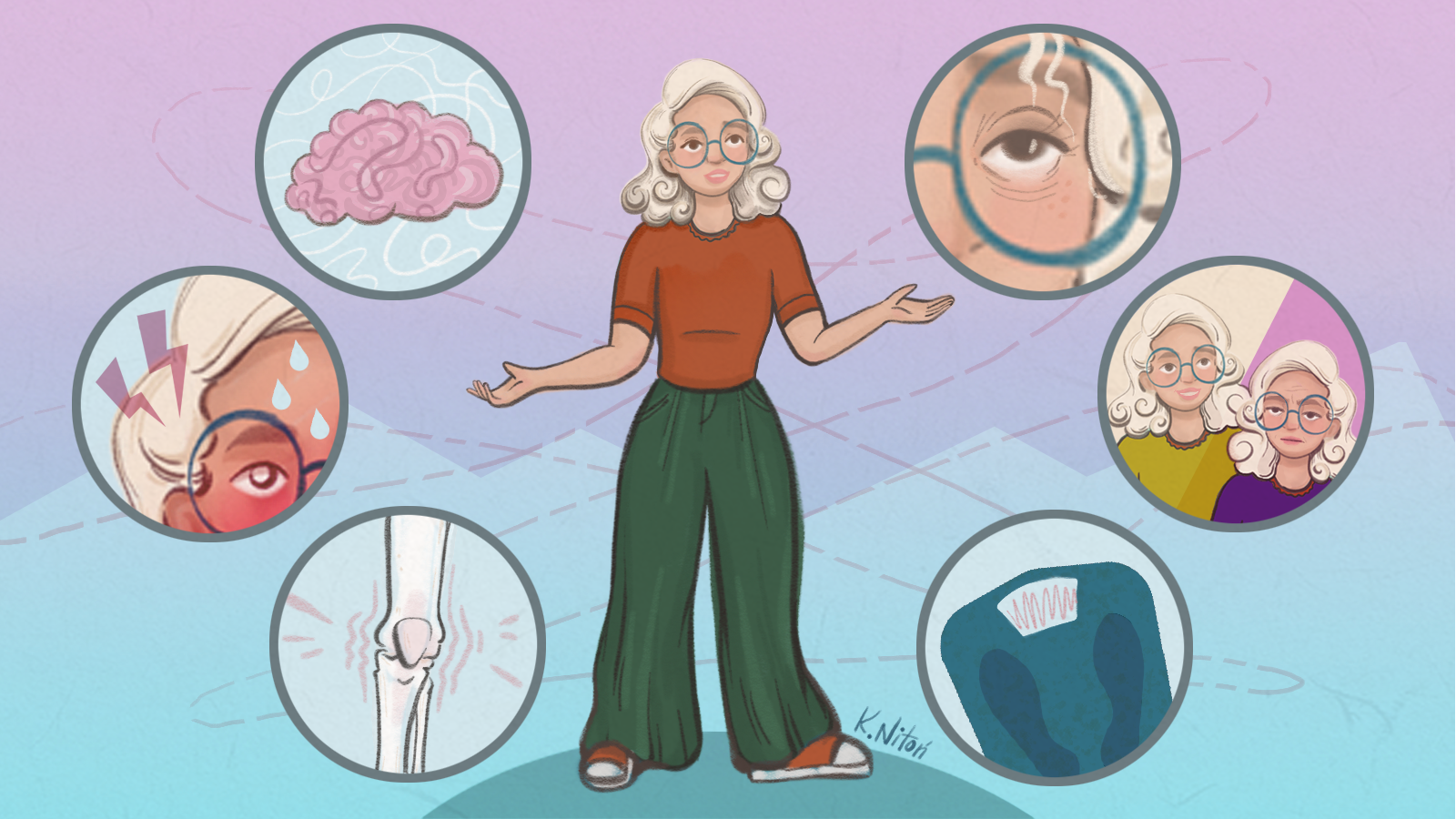
That anxiety bump is compounded for those staring down perimenopause — a mid-life bonus complete with a steep decline in estrogen, a hormone governing everything from mood regulation and cognitive function to sleep patterns and body temperature.
Hot flash, anyone? If you know, you know.
When your estrogen falls off a cliff, it can lead to anxiety, depression, brain fog, and sleep disruption, not to mention bone density loss and increased risk of heart disease. Given that this dramatic life change is non-negotiable, you’d think more women would be braced for impact.
Yet, as Jessica Yaffe writes in her January 13, 2025, The Globe and Mail essay, Once I hit my 40s, I had no idea what was going on with my body, “I thought I had lupus. I thought I had esophageal cancer. I thought I had rheumatoid arthritis. I thought I was losing my mind. Nope … It was just good old menopause.”
As teens, many of us turned to Are You There God? It’s Me, Margaret, but the 10 million mid-life women1 living this reality in Canada today don’t have Judy Blume as their guide. More than half feel unprepared for menopause, while 60 per cent are unaware that depression and memory issues come with the territory.2
Add society’s unrelenting pressure to look youthful, and you have a population that doesn’t see their realities reflected and that’s struggling for validation and support.
In Why We Can’t Sleep, Calhoun explores the unique challenges faced by Generation X women (born 1965-1980) who were raised to believe they could “have it all.” On the basis of interviews with over 200 women, she reveals that many feel exhausted, overwhelmed and underemployed, caught between housing costs, credit card debt, and career stagnation.
Gen X women were promised equality, but they inherited a world that hadn’t changed to accommodate it. They entered the workforce during economic downturns and were told to lean in — thanks, Sheryl Sandberg — while the structural supports like affordable childcare and pay equity never materialized.
If you’re feeling adrift and unfulfilled, you’re in good company.
S*#t sandwich, anyone?
For many, this hormonal balancing act comes at a time when our parents are aging and we’re still caring for young children.
My daughter is newly 14, and my widowed mom is 87. Between managing teen angst and fighting ageism, I’m battling on two fronts. Often, it’s my own mental health that takes a back seat.
I’m not alone. A 2024 Statistics Canada study found that 86 per cent of sandwich generation caregivers said their responsibilities affected their health, with women more likely to experience stress, anxiety, and exhaustion. Among the five per cent for whom menopause coincided with double-duty caregiving, 93 per cent reported negative health impacts and 41 per cent reported financial hardship.
These circumstances quickly deplete internal resources, leaving women and non-binary carers with fully depleted reserves of resilience.
The workplace offers little refuge. Three-quarters of working women feel their employer is either unsupportive or uncertain how to help them manage menopause. The economic cost is staggering: the Menopause Foundation of Canada estimates an annual economic impact of $3.5 billion, including $237 million in lost productivity and $3.3 billion in lost income due to reduced hours, lower pay, or women leaving the workforce entirely.
Wine o’clock: more than a meme
When you combine career angst, hormonal shifts, and identity disruption, there’s a risk at midlife that people will reach for substances to numb big feelings. No wonder you can buy aprons, socks, and framed prints proclaiming it’s “wine o’clock.”
But the humour falls flat when you consider that women’s substance use is often more insidious. While men tend to use substances in a more social and visible way, women are more likely to numb their feelings or hide their use to conform to social norms3. The slope to high-functioning dependency can be steep and slippery, and serious problems can hide behind a glossy veneer of success.
When the data get personal
Mental health challenges at midlife affect all women, but not equally. Nine per cent of women who identify as 2SLGBTQI+ and eight per cent of racialized women reported needing mental health support but not accessing it — nearly double the rates of their non-2SLGBTQI+ and non-racialized peers4.
For Black women, the barriers are more acute. The Voices Unheard survey, which was Canada’s first national health survey focused on Black women and girls, conducted by the Black Women’s Institute for Health, found that respondents were misdiagnosed, ignored, and told they were “too functional” to receive care.
The pressure to appear strong has led to delayed care and isolation. As the survey report states: “When Black women are expected to endure suffering silently, they are denied the support and intervention that could save their lives.”
No Mustang for you!
So, what does midlife support actually look like?
It means recognizing that major life transitions naturally involve questioning and gradual adjustment. A crisis, on the other hand, brings persistent distress, functional impairment, or harmful coping mechanisms.
It means understanding that women’s intense reflection isn’t the hysteria of yesteryear. It’s a legitimate response to profound biological, social, and identity shifts happening simultaneously.
It means creating menopause-inclusive workplace policies; developing accessible, affordable mental health resources tailored to life stages; and addressing hormonal health as part of mental health care.
When we break the silence around menopause and midlife mental health struggles, women don’t have to manage these challenges feeling invisible and alone.
I, for one, would love to watch a feature film starring, say, Kerry Washington, navigating midlife’s tedium, sighing as she looks out a rain-streaked window. (Shonda Rhimes, you got this!)
Thinking back, my dad’s Mustang was about reclaiming youth, freedom, and adventure before time ran out. But a call back to youth or fecundity isn’t what women and non-binary individuals need at midlife. (I certainly don’t plan on rushing out to buy a top-of-the-line pram, just for show. Besides, my Goldendoodle would rebel.)
What we need, rather, is to be seen, supported, and given the resources to navigate one of life’s most challenging transitions, without feeling silenced by stigma or being forced to self-medicate our way through it.
Society has told our generation of women we can have it all. How about we start with the basics?
Where to find support and sisterhood
GreenShield’s Free Women’s Mental Health Program offers culturally sensitive, trauma-informed virtual therapy with personalized matching on the basis of culture, race, language, and religion. Over 120,000 women have accessed these services. greenshield.ca
Mothering Minds (Black Women’s Institute for Health) provides comprehensive, culturally responsive support for Black mothers, with emphasis on peer connection and community. bwhealthinstitute.com
Menopause Foundation of Canada works to close the menopause knowledge gap, improve access to care, and create menopause-inclusive workplaces. menopausefoundationcanada.ca
Respite4ALL (SE Health and GreenShield) supports working caregivers, especially from equity-seeking communities, with respite care and free mental health counselling. champlainhealthline.ca
Mental Health Commission of Canada has curated resources by province and territory in support of caregiver mental health. Caregiver Resources – Mental Health Commission of Canada
Mental Health Commission of Canada’s guide on Where to Find Care. addresses key questions to help you navigate the public and private options available in Canada.
- 1 2025 Women’s Mental Health Report
- 2 2025 Women’s Mental Health Report
- 3 Addiction in Women in Canada: Prevalence, Causes, and Treatment Options – Mental Illness Awareness For Women
- Text box: The Startling Reality of Women’s Mental Health in Canada (New Statistics Revealed) – Health & Wellness Canada
- 4 2025 Women’s Mental Health Report
Author: Suzanne Westover
An Ottawa writer and former speechwriter, and Manager of Communications at the Mental Health Commission of Canada. A homebody who always has her nose in a book, she bakes a mean lemon loaf (some would call her a one-dish wonder) and enjoys watching movies with her husband and 14-year-old daughter. Suzanne’s time with the MHCC cemented her interest in mental health, and she remains a life-long learner on the subject.
Illustrations by: Sunny Street Creative
